The yellow benches for Jews at Olivaer Platz, Berlin 1937
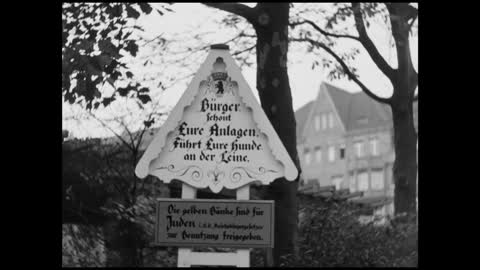
In a small park under a stone pergola, a sign declares that the yellow benches are released for Jews under the Reich Citizenship Law.
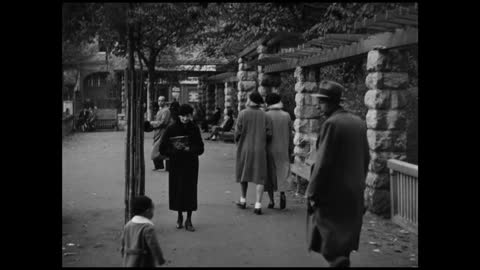
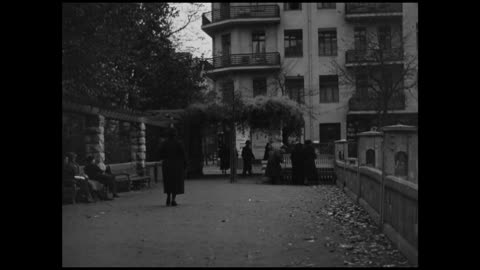
Under a pergola of rough stone pillars in a small park, women in long coats stroll along a path strewn with autumn leaves, a small child toddles after them, and people sit on the benches reading or resting. At the entrance a white signboard with the Berlin bear asks citizens to spare the gardens and keep their dogs on a lead; beneath it a plain board reads: Die gelben Bänke sind für Juden i.S.d. Reichsbürgergesetzes zur Benutzung freigegeben.
The Reich Citizenship Law, one of the Nuremberg Laws of September 1935, had made Jews subjects without civic rights and defined who counted as a Jew. The yellow benches put that definition into the parks. Julien Bryan named the square Oliviaplatz in his lecture Germany 1937; it is the Olivaer Platz off the Kurfürstendamm, in a district where many Jewish families lived.